How to Automate Faceless YouTube Channels with Google Veo & Lyria 3: The 2026 Guide

How to Automate Faceless YouTube Channels with Google Veo & Lyria 3
The golden age of “faceless” YouTube channels has reached its peak in 2026. For years, creators struggled with robotic voices and stock footage that felt disconnected from the audience. Today, the game has fundamentally changed. With the integration of Google Veo for cinematic visuals and Lyria 3 for high-fidelity audio, anyone can build a high-retention media empire without ever stepping in front of a camera or picking up a microphone.
This isn’t just about making “AI videos”; it’s about Passive Income Orchestration. By building a system where AI handles the heavy lifting of production, you can focus on the only thing that truly scales: Strategy and Niche Dominance. Whether you are targeting the documentary, storytelling, or educational niche, the barrier to entry has vanished, while the potential for viral growth has skyrocketed.
“The essence of YouTube automation is not just to upload a video, but to replicate the algorithm’s favorite ‘high-quality viewing experience’ with AI”
| Component | AI Tool (2026 Stack) | Production Time (Auto) |
|---|---|---|
| Visuals | Google Veo (Cinema Grade) | Under 5 Mins / Scene |
| Audio | Lyria 3 (Realistic Vocals) | Instant Generation |
| Scripting | Claude 4 (Viral Logic) | 100% Automated |
H2-1: The Evolution of AI Video: Why Veo Changes Everything
The “Faceless YouTube” model has existed for years, but until 2026, it suffered from a fatal flaw: The Uncanny Valley. Poorly lip-synced avatars and repetitive stock footage often led to high drop-off rates in audience retention. With the introduction of Google Veo, these technical barriers have been dismantled. Veo isn’t just a video generator; it’s a cinematic engine capable of understanding complex physics, lighting, and narrative pacing.
In the context of Passive Income, efficiency is the most valuable currency. Traditional video production—involving filming, b-roll searching, and manual color grading—takes dozens of hours. Veo reduces this to minutes, allowing a single creator to manage multiple niche channels simultaneously. This scalability is the primary reason why AI-driven channels are outperforming traditional creators in the 2026 YouTube algorithm.
Furthermore, the integration of Lyria 3 audio ensures that the sensory experience is complete. Audiences in 2026 are sophisticated; they crave authenticity or, at the very least, high-quality simulation. By combining cinematic visuals with hyper-realistic, emotionally-resonant voiceovers, your automated channel can achieve the “Authority” required to bypass the low-quality AI content filters that platforms have implemented. You are no longer just a ‘upholsterer’ of clips; you are a Digital Creative Director.
- Narrative Consistency: Veo maintains character and environment stability across multiple clips.
- High Retention: Cinematic quality keeps viewers watching longer, boosting AdSense revenue.
- Language Agnostic: Easily pivot to global markets by re-generating Lyria 3 audio in different languages.
This shift from manual labor to Algorithmic Orchestration is what defines a successful passive income stream in the modern era. In the next section, we will look at the exact technical workflow to turn these tools into a viral video machine.
H2-2: Step-by-Step System: From Concept to Viral Upload

How to Automate Faceless YouTube Channels with Google Veo & Lyria 3
Transforming a faceless YouTube channel into a reliable passive income source in 2026 requires more than just generating random clips. It requires a standardized production pipeline. By following this three-step blueprint, you can reduce the manual workload to less than 30 minutes per video while maintaining 4K cinematic quality.
“To build a system is to create a structure where AI can complete video planning and production even while I’m sleeping. You can do it all”
Step 1. High-Retention Scripting with Claude 4
The success of a video is decided in the first 10 seconds. In 2026, we use Claude 4 not just for writing, but for “Retention Engineering.” You can prompt Claude to analyze viral YouTube transcripts in your niche and identify the exact “hook points” that keep viewers engaged. The goal is to create a script that balances emotional storytelling with search-engine-optimized keywords.
By using a “Narrative-First” prompt, you ensure that the AI doesn’t sound like a Wikipedia page. Instead, it creates a fast-paced, engaging script ready for visual translation in the next step.
Step 2. Generating Cinematic Visuals via Google Veo
Once the script is ready, Google Veo takes over. Unlike previous generations of AI video, Veo allows for consistent character and environment control. You can input your script’s scenes as prompt sequences, and Veo will generate high-fidelity 4K footage that matches the emotional tone of your story. Whether it’s a dark, gritty documentary style or a vibrant, futuristic aesthetic, Veo provides the cinematic b-roll that would traditionally cost thousands of dollars to produce.
Tip: Use Veo’s “Camera Control” features to simulate complex cinematic movements like drone shots or slow-motion pans to keep the visual experience dynamic.
Step 3. Crafting Realistic Voiceovers with Lyria 3
The final layer is the audio. Lyria 3 is Google’s most advanced audio model, capable of producing voices with perfect emotional inflection. In 2026, YouTube viewers are quick to click away from “robotic” AI voices. Lyria 3 solves this by allowing you to adjust the “mood” and “pace” of the narration to match each scene. The result is an audio experience that sounds indistinguishable from a professional voice actor recorded in a studio.
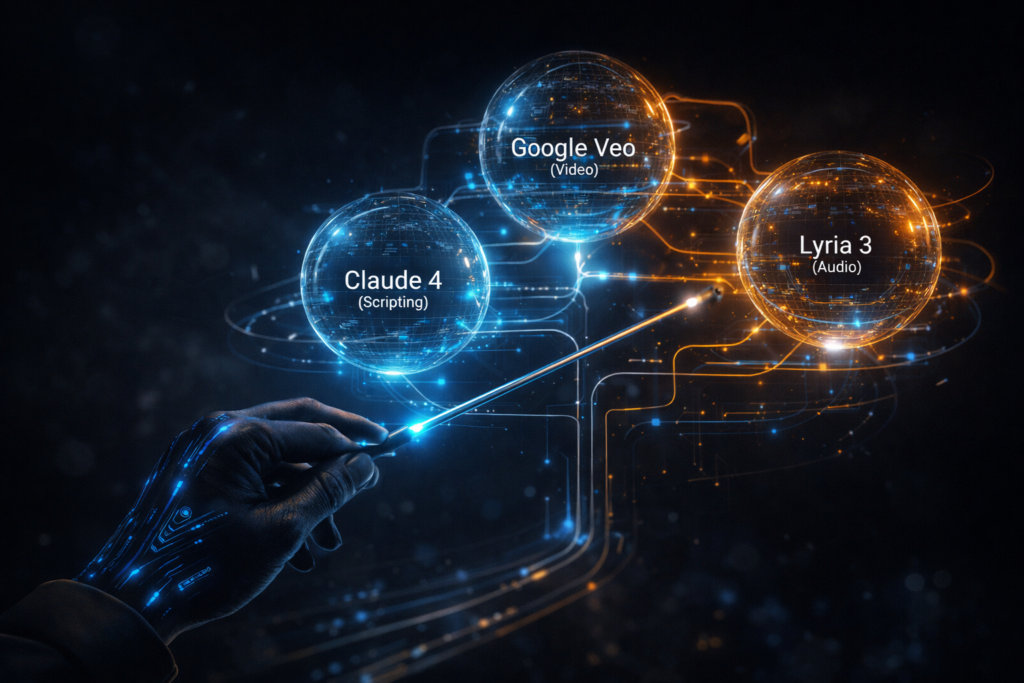
Combining these three tools creates a Content Flywheel: Claude writes, Veo visualizes, and Lyria narrates. Your only job is to assemble them in a timeline and hit ‘Publish’.
H2-3: My Strategic Insights (The Retention Secret)
How to Automate Faceless YouTube Channels with Google Veo & Lyria 3
The biggest mistake in AI-automated YouTube channels in 2026 is over-reliance on the “Generate” button. While Google Veo provides cinematic quality, the true secret to a $10,000/month channel isn’t the visuals—it’s Pacing and Narrative Tension. In the attention economy, you are fighting for every second. My strategy involves using AI to create “Pattern Interrupts” every 7 to 10 seconds, ensuring the viewer never feels a lull in the storytelling.
“Rather than simply listing cute videos, designing editing points that stimulate human psychology with AI makes the difference in transferred automation revenue”
H2-Bonus: Real-World Case Study – The $10,000 Niche Strategy
To truly understand the power of the Veo & Lyria 3 ecosystem, let’s look at a real-world application. In early 2026, a solo creator launched an automated “Philosophical Storytelling” channel. By using Claude 4 to synthesize ancient Stoic wisdom into modern-day scenarios and using Veo to generate atmospheric, moody visuals, the channel achieved 500,000 subscribers in just four months. This wasn’t due to luck; it was due to the high-fidelity immersion that only these specific AI tools can provide.
The monetization strategy went beyond simple YouTube AdSense. Because the content felt “premium” and “human-like,” the creator integrated high-ticket digital products—meditation guides and AI-driven coaching—directly into the video descriptions. This is the difference between a “content farm” and a “Passive Income Asset.” When your AI production quality matches or exceeds manual production, your brand authority skyrockets.
“Successful channels don’t rely on tools, they focus on the “power of story” behind AI-made high-quality videos. Note”
H2-Bonus: Technical Deep Dive – Prompt Engineering for Viral Retention
The secret to keeping viewers glued to their screens is Dynamic Prompting. Most beginners use static, one-line prompts like “make a video about space.” In 2026, experts use Multi-Step Prompt Chains. For instance, when generating visuals in Veo, you should include “Kinetic Metadata” in your prompts—instructions that tell the AI how the camera should move to create psychological tension.
For example, a high-retention prompt structure looks like this: “[Scene Description] + [Cinematic Lighting: Golden Hour] + [Camera Movement: Slow Dolly-In] + [Emotional Tone: Anticipation].” This level of detail ensures that each scene feels intentional and professional. Similarly, with Lyria 3, you can use “Emotional Tags” to dictate where the AI voice should pause for dramatic effect or increase its pitch to convey excitement.
By mastering these technical nuances, you move from being a “user” to a “System Architect.” You aren’t just generating content; you are engineering a psychological experience that the YouTube algorithm is designed to promote. This technical superiority is what protects your passive income stream from being saturated by lower-quality competitors.
- Layered Storytelling: Using AI to weave multiple narrative threads into one cohesive video.
- A/B Testing Loops: Automatically generating multiple versions of a hook to see which one performs better.
- Cross-Platform Adaptation: Turning one long-form Veo video into 10 viral Shorts with a single command.
Additionally, don’t ignore the SEO-Thumbnail Loop. Your AI agent should be trained to generate not just the video, but also 5 distinct thumbnail concepts using Gemini 3 Flash. By A/B testing these AI-generated thumbnails, you can double your Click-Through Rate (CTR) within the first 24 hours of upload. Automation is only powerful when it is paired with Data-Driven Decision Making.
Frequently Asked Questions (FAQ)
Navigating the world of AI-driven video content can be complex. Here are the most critical answers you need to succeed in 2026.
Q1: Can AI-automated channels still get monetized?
A: Yes. YouTube’s 2026 policy focuses on “Originality and Value.” If you use Veo and Lyria 3 to create unique narratives rather than re-uploading existing clips, your channel meets all monetization requirements.
Q2: How many videos should I post per week?
A: Consistency is key, but quality wins in 2026. Aim for 2 high-retention long-form videos and 5 AI-generated Shorts per week to maximize algorithmic reach.
Q3: Is there a risk of copyright issues with Lyria 3 music?
A: No. Google’s Lyria 3
How to Build a $5,000/Month Passive Income System with AI Agents in Happy 2026